

This essay by Anthony Fiumara was written in honor of the La Monte Young-inspired performance during ROADBURN Offroad on April 16, 2026.
Theodor W. Adorno, Philosophie der neuen Musik (1949)Cornelius Cardew, Stockhausen Serves Imperialism (1974)
Jacques Derrida, Spectres de Marx (1993)
Mark Fisher, Ghosts of My Life: Writings on Depression, Hauntology and Lost Futures (2014)
Kyle Gann, American Music in the Twentieth Century (1997)
Fredric Jameson, The Political Unconscious (1981)
Wim Mertens, American Minimalist Music (1980)
Patrick Nickleson, The Names of Minimalism: Authorship, Art Music, and Historiography in Dispute (2023)
Keith Potter, Four Musical Minimalists (2000)
Steve Reich, ‘Music as a Gradual Process’ (1968), in Writings on Music 1965–2000 (2002)
Christopher Small, Musicking (1998)
Susan Sontag, Against Interpretation (1966)
Cecilia Sun, ‘The Theatre of Minimalist Music: Analysing La Monte Young’s Composition 1960 #7’, Context 31 (2006)
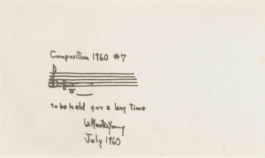
The perfect fifth has a particular ontological status in Western music theory. It is the most stable interval after the unison and the octave – the third overtone of the harmonic series, the ratio 3:2, the foundation of the Pythagorean tuning system that governed the whole of European musical thought before equal temperament. But this very stability makes it strange. It decides nothing. A third immediately evokes a key; a fourth suggests a specific harmonic function; but a fifth floats. Is B the root, then F# is the fifth – but equally F# could be the root, with B as the fourth. Or perhaps this is a dominant seventh without its third and seventh, a sound that wants to resolve but endlessly defers that moment.
Derrida’s concept of hauntology – that what has never taken place is nonetheless present as a spectre, a persisting force that hollows out the actual – is nowhere more audible than in a long sustained drone. The fifth suggests a root without confirming it. It implies a harmonic system without realising it. It carries within it the ghost of tonality – the whole architecture of tension and release, of dominant and tonic, of desire and satisfaction – but does not materialise that architecture. It holds it captive in a state of perpetual deferral.
This is not abstraction. It is what you hear when you listen long enough. After ten minutes the fifth begins to hum with what it is not. Your mind starts filling in melodies that are not there, hearing harmonies the sound does not produce. People who knew Young reported strikingly consistent experiences: a sense of initial impatience, of boredom that slowly becomes something else – more alert, more receptive, opened to subtleties in the sound that were always there but only become audible once the expectation of movement has been exhausted. The listener begins to hear the small fluctuations of intonation in the performers, the acoustic reflections of the room, the slow breathing of the sound in the architecture. The piece becomes a mirror of listening itself – of the way the ear always wants more, always seeks structure, always wants to be on its way somewhere.
And then the drone refuses to satisfy that hunger. It holds you in the wanting.
THE LONG TIME: A CHRONOLOGY
The world premiere of Composition 1960 #7 took place in July 1961 in George Maciunas’s gallery on Canal Street in Manhattan. The ensemble consisted of Maciunas himself and, among others, Yoko Ono, the poet Jackson MacLow, and the Japanese composer Toshi Ichiyanagi, who had recently married Ono. They held the fifth for three uninterrupted hours. There was no announcement of when it would begin. There was no announcement of when it would end.
A year later, Young led a one-hour performance in the same venue where he gave the New York premiere of his String Trio of 1958 – the work that in some respects was the direct precursor to #7, the same obsession with the long tone but still within the chamber music tradition. They appeared on the same programme, the early work and the new alongside each other; which could be read as a quiet statement about the distance Young had covered in four years.
On 11 May 1963, Young, Marian Zazeela (his life partner and artistic companion), Tony Conrad, the percussionist Angus MacLise and others performed the piece for five hours at the Hardware Poets Playhouse in New York. This was already a hint of the direction Young’s work would take: not shorter but longer, not more condensed but more expansive, the temporal horizon of the performance as a parameter as determining as pitch.
The English experimental composer Cornelius Cardew – member of the avant-garde group AMM, later Maoist and author of the brilliant pamphlet Stockhausen Serves Imperialism – led the piece three times in five months in 1966 with widely differing forces: cello, accordion and harmonium at the American Artists Centre in Paris on 1 April; bowed banjo, five guitars, cello, violin and piano at Leeds City Art Gallery in February; an expanded ensemble with bowed amplified sitar, double bass, harmonium, cello and grand organ at the Royal Albert Hall in London on 18 June. The same piece. Each of these performances claims equal right to be the piece. Each sounds different. Each is, in its irreplaceable specificity, Composition 1960 #7.
That diversity is not arbitrary. Young specified no instrumentation, no dynamics, no tuning. Equal temperament or just intonation – that apparently did not concern him at the time. A fortissimo brass ensemble in a large concert hall is a different reality from a choir softly humming the same notes in a whitewashed gallery. But they are the same two notes, and they are held for a long time. That is where the work resides.
THE THEATER OF ETERNAL MUSIC
In 1963 Young, together with Marian Zazeela, Tony Conrad, John Cale – later a member of The Velvet Underground – and the percussionist Angus MacLise, founded the Theater of Eternal Music, an ensemble that practised drone improvisations of extreme duration and extreme intensity. They played sessions lasting many hours in which long tones were sustained, overtones isolated, and the boundaries of what performable music could be were systematically erased. They recorded many of these sessions on tape.
Those tapes now form the centre of one of the most bitter copyright disputes in the history of experimental music. Young keeps them in his archive and refuses to release them. Tony Conrad – who left the ensemble in 1965 following a dispute over artistic control – spent decades attempting to gain access to recordings on which his own work is audible. In 1990 Conrad organised a picket line outside a Young concert, with a sign listing seven complaints, including his conviction that the Theater of Eternal Music was ‘collaboratively founded’ – and named as such precisely to deny the Eurocentric historical teleology embodied in the word composer. By claiming sole ownership of the work, Young was according to Conrad responsible for the ‘artistic demolition of this body of work’.
THE TWO FACES OF STASIS
It is tempting to treat minimal music as a single movement, but its internal tension matters. Young on one side, Reich and Glass on the other: both parties share a refusal of traditional harmonic progression, a refusal of the musical narrative moving from A to B to C with a functional necessity that has been drilled into listeners for centuries. But the political valence of that refusal differs considerably.
Steve Reich – who spent a brief period in Young’s immediate circle in the early 1960s and absorbed his thinking about long sustained tones – developed his own aesthetic of repetition. His phasing music, beginning with It’s Gonna Rain(1965) and Come Out (1966) and culminating in Music for 18 Musicians (1976), works with small musical cells that move past each other in phase, so that the rhythm of perception itself forms the structure of the work. Philip Glass, who knew Reich and had briefly played cello with Young, built arpeggio structures that circulate like tides, recognisable and almost catchy in their repeated patterns.
This is not the same stasis as Young’s. The music of Reich and Glass has a logic, a direction, a beginning and an end. It is process-based in the sense Reich himself described in his manifesto Music as a Gradual Process (1968): you can see how it works, you can understand the rules, you can follow the system as it unfolds. It is no accident that this music found its way into film scores and into the muted background of aircraft cabins and hotel lobbies. Harmonic stasis as relaxation product. Immobility as comfort.
I say this not to disparage Reich and Glass: their work is too complex and too compelling to reduce to decoration. But there is a difference in intractability. Young never accommodated. His music has always remained user-hostile: always too long, always too quiet or too loud, always too unwilling to give the listener what they have been conditioned to expect.
DREAM HOUSE: THE DRONE AS ARCHITECTURE
After 1960, Young’s thinking radicalised. In the second half of the 1960s he began working with Zazeela on what would become the Dream House: a permanent installation of live electronic drones and coloured light, an environment that physically envelops visitors and has neither beginning nor end. The drone is no longer a performance in the traditional sense – temporary, with a start and a finish – but a condition, an architectural reality that exists as long as the installation runs.
The Dream House that Young and Zazeela maintained in their loft on Harrison Street in Tribeca, New York, which they opened in 1993, was open to visitors for years. The room was dark, threaded with coloured light and a complex network of sine waves – pure tones in fixed ratios to each other, just intonation taken to its furthest extreme. The overtones generated in the interference of those sine waves moved through the space so that visitors could hear them shift as they walked through the room: the acoustics became an instrument, the body a means of perceiving the spatial architecture of sound.
This connects directly to Young’s fascination with just intonation – the system of interval ratios based on the harmonic series, which replaces the equal temperament of the modern piano with ‘pure’ frequency relationships. In equal temperament all intervals except the octave are slightly mistuned, so that all keys are equivalent but none is perfect. In just intonation the fifth sounds purer, the triad more open, the overtone structure of the sound richer – but the system works only in one key at a time, and modulation is in principle problematic. Young chose just intonation and abandoned modulation. Logical: whoever never wants to go anywhere has no need of the means to get there.
THE STRUGGLE OVER THE WORK
Tony Conrad’s quarrel with La Monte Young is not merely a copyright dispute. It is a symptom of a deeper contradiction lodged in the music itself – and, more broadly, in the entire political economy of artistic work.
Conrad believed that what they made together in the Theater of Eternal Music – the result of group improvisation, of shared listening and shared sonic presence over years – was not appropriable. That it was musicking, to use Christopher Small’s word: an activity, a relationship, something that exists in the performance and not outside it. Young claimed his rights as composer over what Conrad considers a collective creation. He wanted to return the work to the very model his own earlier compositions had contested: the musical object as the private property of its maker.
That is the irony. Music that began as an attack on the commodification of art is itself commodified – not because its makers are bad people, but because the system has already anticipated all those escape routes and neatly enclosed them. Young claims the drone. Musicology writes analyses of it. It is absorbed into the canon. And gradually something that was once a radical act becomes a historical monument. Conrad’s picket line in 1990 was an act of desperation – an attempt to keep the political character visible at the very moment it threatened to harden into artefact.
The musicologist Keith Potter wrote in his book Four Musical Minimalists that one of his aims was to give minimal music the analysis it had never had but deserved. Deserved – as if the avant-garde had been waiting for the academy’s approval to confirm its status as Great Art. As if the most radical thing about Young’s work was not precisely that it did not need that approval, did not want it, actively ran from it.
WHAT REMAINS: THE INDIGESTIBLE
And yet. Turn the sound on. Hold the B and the F# for a long time. And notice what happens in the room, in your body, in the relationship between you and the sound.
The drone does not escape the system. Nothing escapes the system. But there is something in it the system cannot replace with a representation of it. You can photograph a sculpture by Morris and sell that photograph. You can record Composition 1960 #7 and stream it. But the recording is not the drone. The drone is what happens when you are inside it, when time passes and nothing changes but yourself. That process – the listener shifting while the sound stands still – cannot be archived. It exists only in the performance, and the performance exists only in the moment, and the moment is always already past by the time you try to hold it.
This is precisely what capitalism cannot digest. Not the piece as text, as historical artefact, as object of study: it can handle all of that. But the duration itself. The three hours. The five hours. The irreducible necessity of being there, of letting the fifth do what it does in the time it takes. That cannot be exchanged for a better version, cannot be summarised in a soundbite, cannot be compressed into something saleable. The attention the piece demands is exactly the kind of attention capitalism has systematically managed to reduce, fragment and monetise. A three-hour drone does not fit in a playlist. It cannot be streamed. It cannot be liked.
In 1960 there were people who believed the future would look essentially different. That the walls of art would be torn down, that the distinction between maker and audience would dissolve, that sound would become a commons owned by no one and inhabited by everyone. That future did not come. But the drone is still sounding. Like a ghost, like a promise never redeemed but never definitively broken. Two notes. A fifth. For a long time.
This essay by Anthony Fiumara was written in honor of the La Monte Young-inspired performance during ROADBURN Offroad on April 16, 2026.
Theodor W. Adorno, Philosophie der neuen Musik (1949)Cornelius Cardew, Stockhausen Serves Imperialism (1974)
Jacques Derrida, Spectres de Marx (1993)
Mark Fisher, Ghosts of My Life: Writings on Depression, Hauntology and Lost Futures (2014)
Kyle Gann, American Music in the Twentieth Century (1997)
Fredric Jameson, The Political Unconscious (1981)
Wim Mertens, American Minimalist Music (1980)
Patrick Nickleson, The Names of Minimalism: Authorship, Art Music, and Historiography in Dispute (2023)
Keith Potter, Four Musical Minimalists (2000)
Steve Reich, ‘Music as a Gradual Process’ (1968), in Writings on Music 1965–2000 (2002)
Christopher Small, Musicking (1998)
Susan Sontag, Against Interpretation (1966)
Cecilia Sun, ‘The Theatre of Minimalist Music: Analysing La Monte Young’s Composition 1960 #7’, Context 31 (2006)
webdesign: anneroos goosen
built by: remco van dun
© 2025 het concreet